
How to Read a Peptide Certificate of Analysis Line by Line
To read a peptide certificate of analysis, work top to bottom: confirm the batch and lot identifiers, check the testing methods listed, compare the purity figure and identity data against the stated specification, then verify the lab and date. If you are sorting through where to buy research peptides online set aside 15 to 20 minutes. No chemistry degree is required, only patience and a willingness to question a document that looks too tidy.
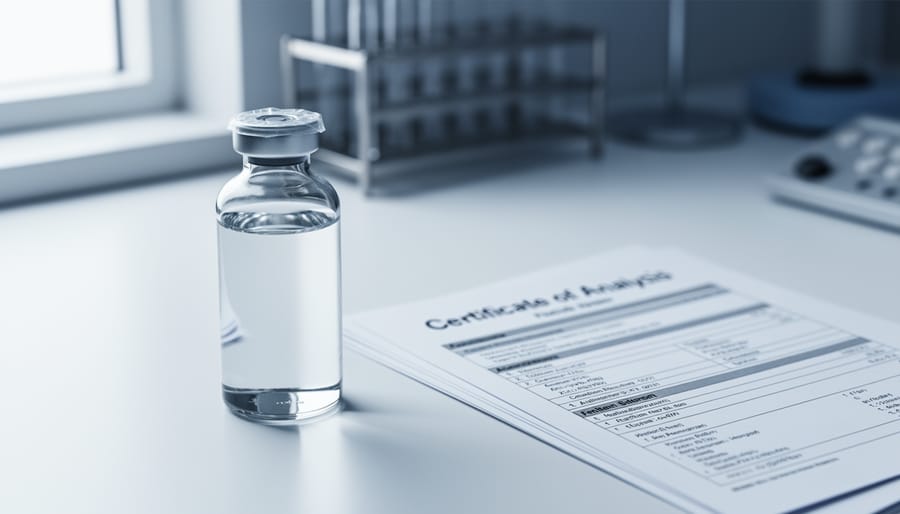
A COA is a batch-level report card. It tells you what a lab measured in one specific production lot, not what a brand hopes you’ll believe about its whole catalog. That distinction matters more every year. As niche wellness markets mature, batch-level transparency is becoming a baseline expectation, much like the shift toward clear sourcing in other categories, and marketers who publish these documents need to present them honestly rather than as sales collateral.
If you’re comparing suppliers, the COA is the first document worth scrutinizing. The same instinct that drives SEO marketing basics, verifying claims against evidence, applies here.
This walkthrough covers what each line means, which numbers carry weight, and the red flags that suggest a document deserves a second look. It’s about document literacy only, not dosing or outcomes.
What You Need Before You Open the Document
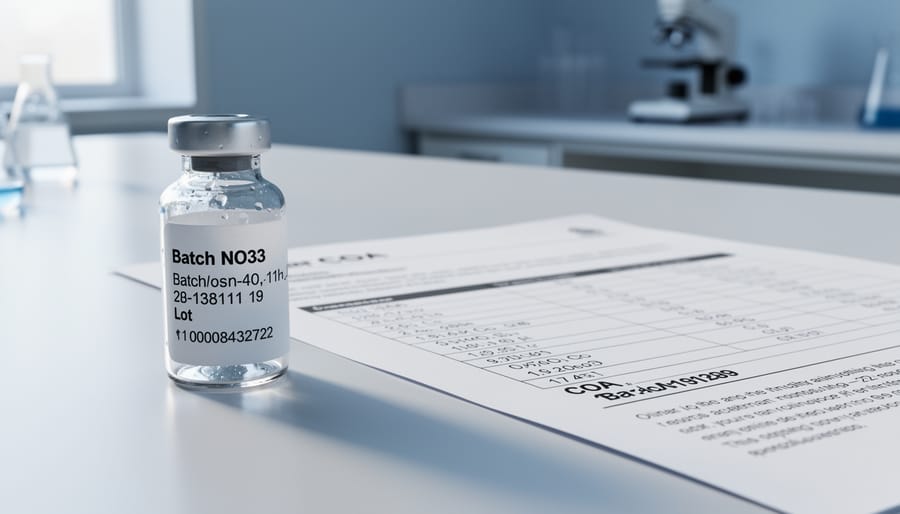
Before you read a single line, gather your materials. A COA only means something when you can check it against the product it claims to describe, so a little prep saves a lot of guesswork.
Here’s what to have in front of you:
- The full COA as a PDF, not a screenshot, crop, or summary.
- The batch or lot number printed on the vial or shown on the product page.
- The product label and any marketing claims tied to that listing.
- The expected molecular weight for the named peptide, from a reputable reference.
- The issuing lab’s website, contact details, or verification page.
- A simple note-taking template for recording what matches and what doesn’t.
The full document matters because screenshots hide things: missing pages, trimmed headers, absent chromatograms. A cropped image is often where a problem lives.
Keep the physical label or product page beside the COA, too. Most COA mistakes aren’t exotic chemistry. They’re mismatches: a different peptide name, a batch number that doesn’t line up, a stated amount that disagrees with the label. You’ll only catch those if both documents are visible at once.
There’s an ethical angle worth stating early. If you publish or reference a COA in your marketing, you should be able to explain it in plain language. Posting a document as a trust badge while having no idea what it says isn’t transparency. It’s decoration, and savvy buyers and platforms are increasingly able to tell the difference.
Safety Warnings and Red Flags: When to Stop Reading and Walk Away
A certificate of analysis is evidence about one batch, tested at one moment, by one lab. It isn’t a safety guarantee, and it doesn’t make a product approved for human use or replace professional guidance. Treat it as a record of what a sample contained, nothing more.
Before you read a single result, check for the conditions that end the review on the spot:
– No batch or lot number. Without it, the document can’t be tied to the vial in your hands.
– No lab name or contact details. If you can’t reach the lab, you can’t verify anything.
– Edited or low-resolution documents. Blurry scans, mismatched fonts, and misaligned tables suggest tampering or a recycled template.
– Results that don’t match the product. A different peptide name, molecular weight, or fill amount than the label means this isn’t the right paper for this product.
– Claims that a COA proves therapeutic effect. No lab report shows that a peptide works or is safe for anyone.
That last point matters most for marketers. Ethical promotion means a COA stays a document-quality signal, never a health or efficacy claim. Pointing to a clean report to imply a benefit is the fastest way to lose credibility with buyers, platforms, and regulators.
If any stop condition appears, stop reading and ask for corrected documentation before the product goes anywhere near a campaign.
Reading the Certificate of Analysis Step by Step, Line by Line
The Header: Who Tested It, and Is It Really This Batch?
Start at the top of the page, because the header tells you who vouches for everything below it. Look for the lab’s name, any accreditation or certification statement (such as ISO/IEC 17025), and working contact details. A lab with no address, phone number, or email is a lab you can’t question. Handling credentials the way you’d treat account protection helps here: if you can’t verify who’s behind the login or the letterhead, don’t trust it.
Next, check the product name, batch or lot number, test date, report date, and sample description. Hold the physical vial or product page beside the document. The batch number must match character for character. A COA that lists a “batch” format different from your label, or one that omits the number entirely, may have been reused across several production runs. That’s a real problem, because purity can differ from one batch to the next.
Also note who did the testing. An in-house report comes from the manufacturer itself, so it’s a claim, not a check. An independent third-party lab has no stake in the result, which makes its findings more credible.
Here’s the full walkthrough in the order a COA typically appears:
- Header and lab identity: confirm the lab name, accreditation, and contact details.
- Product name and batch number: match both against your physical label.
- Test date and report date: check they’re plausible and in sequence.
- Appearance: read the physical description of the sample.
- HPLC purity: find the reported percentage.
- Chromatogram: look for one dominant peak.
- Mass spectrometry identity: compare measured and expected molecular weight.
- Quantity or net content: separate fill amount from total mass.
- Other tests: note endotoxin, residual solvents, and water content.
- Method references: confirm which testing methods were used.
- Signature and verification: look for a signatory and a way to verify the report.
The sections below expand the lines that need more explanation.
Purity and the Chromatogram: What the HPLC Result Is Telling You
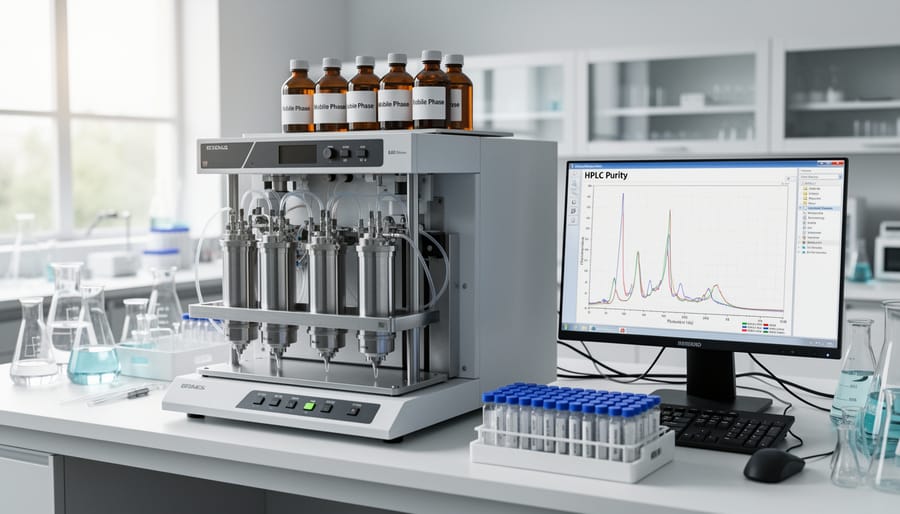
HPLC stands for high-performance liquid chromatography. In plain terms, the lab dissolves a small sample, pushes it through a column, and the different molecules in it come out at different times. A detector records each one as a peak on a graph. That graph is the chromatogram, and it is the visual proof behind the purity number on the COA.
Here’s how the math works. The lab compares the area under the main peak to the combined area of all peaks. If the main peak accounts for 98.5% of the total, the report states purity of 98.5%. Everything else, including leftover fragments and byproducts from synthesis, shows up as smaller peaks.
When you look at the chromatogram itself, you want one tall, sharp peak that clearly dominates, sitting on a flat, quiet baseline. A crowded graph with several mid-sized peaks, or a baseline that wobbles and drifts, tells a different story, even if the headline percentage looks respectable. Check that the axes are labeled, that the sample name and batch number appear on the graph, and that the peak marked as “main” is actually the biggest one.
Be cautious when a COA lists a purity percentage with no chromatogram attached. A bare number can’t be checked, and it’s easy to copy from one document to another. Ask for the full trace before treating it as evidence.
One more distinction trips people up: purity is not quantity. A vial can be 99% pure and still contain far less peptide by weight than the label’s fill amount suggests, because salts, water, and counterions take up mass. Purity describes the makeup of the peptide present, not how much of it there is.
Identity Confirmation: Mass Spectrometry and Molecular Weight
Purity tells you how clean the sample is. It doesn’t tell you whether the clean thing is the right thing. That’s the job of mass spectrometry (often shown as MS, LC-MS, or MALDI-TOF), which weighs the molecules in the sample and reports their molecular weight.
Here’s the practical check. Find the “expected” or “theoretical” molecular weight on the COA, then find the “observed” or “measured” value. Your reference figure from earlier goes next to them. For a peptide of a few thousand daltons, the two numbers should land very close, typically within a fraction of a dalton, or within one or two daltons on simpler instruments. A reading like 4,027.9 measured against 4,027.6 expected is a convincing match. A gap of tens or hundreds of daltons is a problem, not rounding.
Also look at how the measured value is presented. Some reports show charged forms, such as +2 or +3 ions, with different numbers than the full molecular weight. A good COA labels these or calculates the converted value so you aren’t left guessing.
A COA that reports 99% purity but includes no identity test leaves a real gap. A highly pure sample of the wrong molecule would still score beautifully. If the mass data is missing, treat the document as incomplete and ask the seller for it before relying on anything else it says.
Quantity, Contaminants, and the Extra Tests
A COA can show a vial with 10 mg of powder in it and still tell you very little about how much peptide that is. Total mass counts everything in the vial: the peptide, plus water and counter-ions left over from synthesis, such as TFA salts. Net peptide content is the share of that mass that is actually the peptide, often reported as a percentage. A 10 mg fill at 70% net content holds roughly 7 mg of peptide. If a COA gives only a fill amount and no net content, treat the quantity as unverified.
Then come the extra tests. They’re optional, but each answers a specific question:
– Endotoxin: flags bacterial contamination byproducts, and matters most for anything intended to be injected.
– Sterility: confirms no viable microbes. Again, this carries weight when the claims touch on injectable use.
– Residual solvents (TFA and others): shows leftovers from synthesis and purification.
– Water content: explains part of the gap between mass and net peptide.
– Heavy metals: reveals trace contaminants from raw materials or equipment.
Which ones matter depends on the claims being made. A brand that talks about purity and quality control should be able to back that up with several of these, not just an HPLC trace.
One last point: the absence of a test is information too. If a COA skips endotoxin or sterility, don’t assume the result was good. Assume nobody checked.
Verifying the Result and Deciding What Happens Next

A COA only counts once the issuer confirms it. Start by emailing or calling the lab directly, using its published contact details rather than anything printed on the document. Give them the batch number and report ID, and ask whether that report exists and whether the results match. Next, look for a verification link or QR code, and make sure it opens on the lab’s own domain, not a lookalike. Then compare formatting and dates: fonts, logos, layout and report numbering should match other reports from the same lab, and test dates should fall before the report date and the sale date. Finally, check that the lab is real, reachable, and actually offers the tests listed.
From there, the decision path is simple. If everything lines up, pass it. If something is missing, such as a chromatogram or an identity test, ask for clarification and give the seller a fair chance to answer. If the batch doesn’t match, the lab can’t be reached, or the document looks altered, reject it and move on.
Marketers have a few extra steps before going public. Get written permission to reference the COA, describe it as a document about a batch and nothing more, and keep the report, the lab confirmation and your correspondence on file. Treat it like any other quality check in your workflow, much like running content SEO reviews before publishing. Keeping those records also makes it easier to handle customer questions about where a claim came from.
One more thing worth watching: batch-level transparency, with scannable QR verification, is becoming an expectation in niche wellness markets. Brands that make verification easy will look more credible than those that don’t.
Common Questions About Peptide COAs
What purity percentage is considered good?
There’s no universal pass mark, but many buyers look for 98% or higher by HPLC, paired with a chromatogram showing one dominant peak. A high number with no chromatogram attached tells you very little.
Is a COA the same as FDA approval?
No. A COA describes what a lab found in one batch. It says nothing about whether a product is approved, safe, or effective for any use.
Can a COA be faked?
Yes, which is why verification matters. Contact the issuing lab with the batch number and report ID, and treat edited or low-resolution documents as a reason to stop.
Why do two COAs for the same peptide look different?
Labs use different templates, methods, and test panels. Compare the underlying data, such as purity, identity confirmation, and net peptide content, rather than the layout.
A few practical notes follow from those answers. A COA is batch-specific, so a new batch needs a new report; there’s no fixed update schedule worth trusting over a matching lot number. An independent lab’s report generally carries more weight than an in-house one, though neither replaces the other checks above.
For marketers, responsible use is simple. Get permission before publishing a COA, describe only what it shows (purity, identity, contaminants tested), and never imply it proves a health outcome. Treat that restraint as part of your credibility, the same way you’d treat ranking factors as signals of trust you earn over time rather than shortcuts to shortcut. Keep copies of every report on file so any claim you make can be traced back to a document you’ve actually verified.
Reading a COA line by line is a ten-minute habit: confirm the header and batch number, check the chromatogram, match the molecular weight, then note which tests are missing. Picture a campaign pulled the day before launch because the batch number on the report didn’t match the vial. That’s an annoying afternoon, not a crisis. As buyers and platforms scrutinize wellness claims more closely, credibility and ethical promotion become real competitive advantages. Build COA review into your content approval workflow, and let the document earn the claim.